|
|||||||


| Bream Anglers Tavern Drop in here if you're just surfing with a beer in your hand. Good place to just hang out... |

 |
|
|
Thread Tools | Rate Thread | Display Modes |
|
|||||||
| Bream Anglers Tavern Drop in here if you're just surfing with a beer in your hand. Good place to just hang out... |
|
|
|
Thread Tools | Rate Thread | Display Modes |
|
#1
 14-04-2005, 03:01 AM
|
||||
|
||||
|
Swim bladder problems
Had a deep water bream session in the Harbour today, all the bream came up with swollen guts from the swim bladder expanding. One fish wouldn't recover and we had to puncture the bladder to release the air for it to swim down.
Has anyone had this happen before? We do a fair bit of deep water work for bream and I've never seen this problem before.
__________________
Cheers, Andrew 
|
|
#3
14-04-2005, 03:22 AM
|
||||
|
||||
|
I've been tossing up about getting a release weight for this sort of thing. To be honest, it's not something I'd be confident doing in a comp situation just yet.
__________________
"How people treat you is their karma; how you react is yours." https://www.facebook.com/groups/BreamOnFly/ ---------------------------------------------- 
|
|
#4
14-04-2005, 03:22 AM
|
||||
|
||||
|
Zac,
They're on a mates camera, I'll get them tomorrow. There's not much to see though, basically the gut was very swollen and the fish kept floating on their sides when released. I should have mentioned that we usually fish water 12-18m deep, but today we were in 20-25m water.
__________________
Cheers, Andrew
|
|
#5
14-04-2005, 03:24 AM
|
||||
|
||||
|
Quote:
__________________
Cheers, Andrew
|
|
#7
14-04-2005, 03:54 AM
|
||||
|
||||
|
There has been a lot of discussion about this with Bass on other sites and the death rates of fish coming up from this level. As I've said, I'd not be confident doing it to bream in a comp where they have to sit in a tank for a period of time.
__________________
"How people treat you is their karma; how you react is yours." https://www.facebook.com/groups/BreamOnFly/ ----------------------------------------------
|
|
#8
14-04-2005, 05:51 AM
|
||||
|
||||
|
Quote:
We only punctured one fish as a last resort, it swam away fine after I massaged the air out.
__________________
Cheers, Andrew
|
|
#9
14-04-2005, 06:36 AM
|
||||
|
||||
|
I dive alot for a mate who owns an aquarium, has a double degree in marine biology and has dived and fished for a very long time. We bring fish up from 20 metres locally but even with all of our skill and experience mortality rates are still around 5 to 10%. Our fish dont suffer the same stress as line caught fish has we catch them by hand and even then they are decompressed on the way up.
Funny that fish need decompression. We somtimes chase them towards the surface and wait for them to come back as the pain kicks in. We often surface decompress them first but to trully look after the fish you need a sterile cannula (large gauge needle). You have to pierce them underwater and quickly remove the needle as the bubbles stop.We use one needle for one fish, and them send them down to slowly decompress as we complete our own surface interval. Most guys say yeah i piecred it and it swam away fine. What they dont know is it died a horrible infectous death 24 hours or less later. I think that the release weights are probably the way to go but even then if a fish gets to the bottom and shows any type of stress what so ever it quickly becomes food for the rest. I have seen it many a time.
|
|
#10
14-04-2005, 07:18 AM
|
||||
|
||||
|
Thanks for the reply mate, very informative.
I'd never pierced a fish's swim bladder until today, and I didn't actullay do the piercing today. My mate that was with me did it, he has a degree in marine biology and new exactly where to pierce the fish. I held the fish in the water and massaged the last bubbles out of it. It swam away fine as soon as it could hold itself upright. So how do release weight work? Is there any easy way to revive the deep water bream so that they'll last in a livewell?
__________________
Cheers, Andrew
|
|
#11
14-04-2005, 07:33 AM
|
||||
|
||||
|
If the release weights are anything like what they use on amberjack etc. I think they involve a downturned hook bolted to a heavy sinker, which is attached to a rope. The rope is fed out to get the fish's head down and sink it back to its original depth, before it is given a quick upward jerk, which pops the hook out of the fish's mouth.
I don't see why this wouldn't work, but I imagine it would have to be very small and unintrusive to work on a bream? Considering their small size and their smallish bony mouth, shoving a sturdy (It's got to be strong enough to pop out at a jerk) hook in their gob to get them back down again mightn't be such a good option. Mind you, I gleaned this from reading a few mag articles and watching iFIsh, so I can't be definite about its truth. On a sadder note, it often happens that a fish might swim strongly off and sometimes even behave normally for a while. only to die soon after, so as much as we'd all like to believe that fish are OK upon release, we can't just let it be 'Out of sight, out of mind' and we've got to do whatever we can for the fish with some kind of scientific basis... Which leads me to wonder, squeezing air out of the swim bladder might let water inside mightn't it? I'm thinking it'd be the same basis as squeezing a turkey bastor under water...air comes out, water goes in, though it's granted that flesh does close around a wound, acting as much like a one-way valve as possible. Still, Swoffa, your mate knew what he was doing, so I don't doubt he did his best for it. Just as you did by massaging the air back out of it. Owen
__________________
My name's Jack, and that lure's MINE!!!
|
|
#12
15-04-2005, 02:04 AM
|
||||
|
||||
|
Quote:
I was talking to someone today about research on yellowbelly in which they had the swim bladders puncturesd and were kept in pens for observation. Apparently most of the fish ended up dying within 24 hours. Not a good sign... Quote:
It was a last resort as I said.
__________________
Cheers, Andrew
|
|
#14
15-04-2005, 05:09 AM
|
||||
|
||||
|
Fair point Swoffa, gently and slowly massaging it should've negated most of the fluid leakage. I do agree that the release mechanism wouldn't help the live-well issue, but the whole physical problem means that you'd either have to puncture your fish or pressurise your livewell, one which is hazardous to the fish and the other is very likely impossible to do for any length of time.
__________________
My name's Jack, and that lure's MINE!!!
|
|
#15
17-04-2005, 03:41 AM
|
|||
|
|||
|
G,day swoofa.First time I have heard that bream are suffering from Barotrauma symptoms.considering they are from the same family as Pinkies i wouldn't of thought there would be a problem.
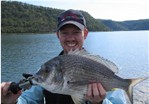
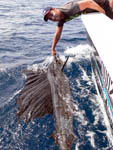
What we do for Pinkies is drop them flat on the surface this tends to get them going. One Pinkie has been recaptured 5 times twice being over the legal limit and this fish has been released and caught in 90m of water. release weight its simple to use.you may have to get the hang of it but when you do its simple.It works believe me all our recaptures have proven this through the data. I would suggest to make your own for releasing Bream I have attached 2 pics. Bigger the fish/species the bigger the weight. Its basically a barbless hook that is inserted into the fishes lip with the weight hanging below that ( Bream you may need to find a soft spot) attached to a line that should be always ready to be used.We have an old set up when we go offshore that is always ready. Ask away if you need more info Wally
|
|
|
|





 Linear Mode

